
Blueberry Farm
Ever my idea of heaven on earth

One recent night, as insomnia robbed me of the peaceful sleep to which I’d become accustomed and to which I had always believed I was entitled, I remembered a memorable “what a small world” experience I had many years ago.
In the early 1990s I lived on Long Island, having moved there from Maine to attend graduate school. My ex-husband, to whom I was married at the time, needed a melanoma removed on his cheek and a subsequent skin graft. We were sent to a plastic surgeon on Fifth Avenue in Manhattan to examine him and arrange for the surgery.
While he was being seen, I remained in the beautifully appointed waiting room. I picked up a copy of Town and Country. As I flipped through the glossy pages with advertisements replete with understated but luxurious goods, reading snippets of articles, I came to an article that startled me. The accompanying photograph showed a lovely older woman in tasteful blue cable-knit cardigan and simple blouse and skirt standing before a stately white house with a big front porch that was flanked by hydrangeas and other beautiful shrubs and trees, including birches.
I recognized this woman instantly. It was my great-aunt Cecelia, and that was Blueberry Farm, in Camden, Maine, where I spent many wonderful summers as I was growing up. My great-grandparents bought that farm at the turn of the last century, and the original structure goes back to the 1800s. They lived in Philadelphia and then Florida and escaped the heat to spend summers in Camden. At first it was steamship to train to horse drawn carriage, then train to motor car. My great-great-grandmother, known as Nana, spent her last summers there. My great-grandmother died on the train heading to Maine from Florida at the end of a long and productive life of philanthropy and public service.
The magazine had chosen to interview my great-aunt, an amazing woman of philanthropy and public activism herself, for reasons I do not now recall. I sat there in that waiting room, stunned to see my favorite place in all the world, Camden and Blueberry Farm in particular. Blueberry Farm, now rather famous locally for the alpacas my cousin raises, remains in the family to this day and is lovingly lived in year-round and cared for by my cousin and her husband and visited by many of us from far and wide. I was there just a year ago and it remains a delightful place. There is something about an old, rather sprawling and well-kept Maine farmhouse that is unlike any other. White, well-porched, amid ferns and other greenery, wide front steps, screened front door that bangs just so as anyone comes or goes, the nearby barn that once held ancient, green canvas-built Old Town canoes.
When I was young I happily stroked across Megunticook in one of those green canoes, first with my mother who taught me canoeing, and as a teen staying with my grandmother and cousins many summers, and last with my dear husband. He was raised in New York and never before in a canoe, may he rest in peace, the two of us yelling at each other to paddle this way and that to try to move straight ahead rather than in circles, amusing some folks at a nearby waterfront camp that day. I know how to steer a canoe from the aft position, but he had no clue what he should be doing, but was sure he did.
Blueberry is a place where, from my first visit at eight or nine I had great summers picking blueberries, nibbling wild wintergreen leaves, canoeing, fishing, swimming in the lake, trekking to the Smiling Cow for balsam pillows and spruce gum, and a little wood cabin into which balsam incense could be ignited to create smoke that went out the chimney. They still sell them and I bought one a few years ago. Seeing the Belted Galloway cattle we called “Belties” and whom I’ve heard others call Oreo cows, was always a treat and remains a favorite outing for me to this day. Another trek was heading up the coast to Perry’s Nuthouse where my mother used to visit as a child in the 1920s, and where my uncle Rod happily held up a dessicated and varnished baby alligator lamp with the cord coming out of its rear end, begging my grandmother to buy it. I am quite certain that stately Chestnut Hill matron said no.
The most arduous trek of all was hiking up to Maiden’s Cliff in the Camden Hills, some 800 feet high, and taking up to an hour to reach via a steep trail. Long ago a girl fell from there to her death and a cross large enough to see from the lake marks that spot to this day. A family friend would take groups of us cousins, with Hershey’s chocolate bars to enjoy when we finally got there. Of course we climbed smaller Mount Battie with its stone tower. One can see Camden Harbor with its windjammers and many other boats and some of the islands in Penobscot Bay, and turning around can see the taller Camden Hills. Edna St. Vincent Millay composed her poem “Renascence” memorializing that view. The lines, “All I could see from where I stood Was three long mountains and a wood; I turned and looked the other way And saw three islands in a bay” describe it well.
We moved to Maine from the Midwest in the 1980s and my son grew to love Camden and the whole surrounding area as much as I did. He knew Aunt Céce and picked berries and, courageous as he was as a kid, swam in the icy water at Lincolnville Beach on Penobscot well into the fall. As a scout he portaged a canoe in and around Moosehead Lake way up in Piscataquis County and I couldn’t have been more proud. Another summer he worked in the blueberry fields, hard stoop labor raking blueberries into buckets, and camping in a tent alongside his fellows, getting a dark tan after his sunburn eased. My mother went to Camden a lot before and after my dad died and eventually retired there. She was born in a sprawling house near Blueberry Farm that her parents owned, on their annual summer stay, and she died nearby in 2005. By then I had lived in New York for over 20 years, and now live in Florida.
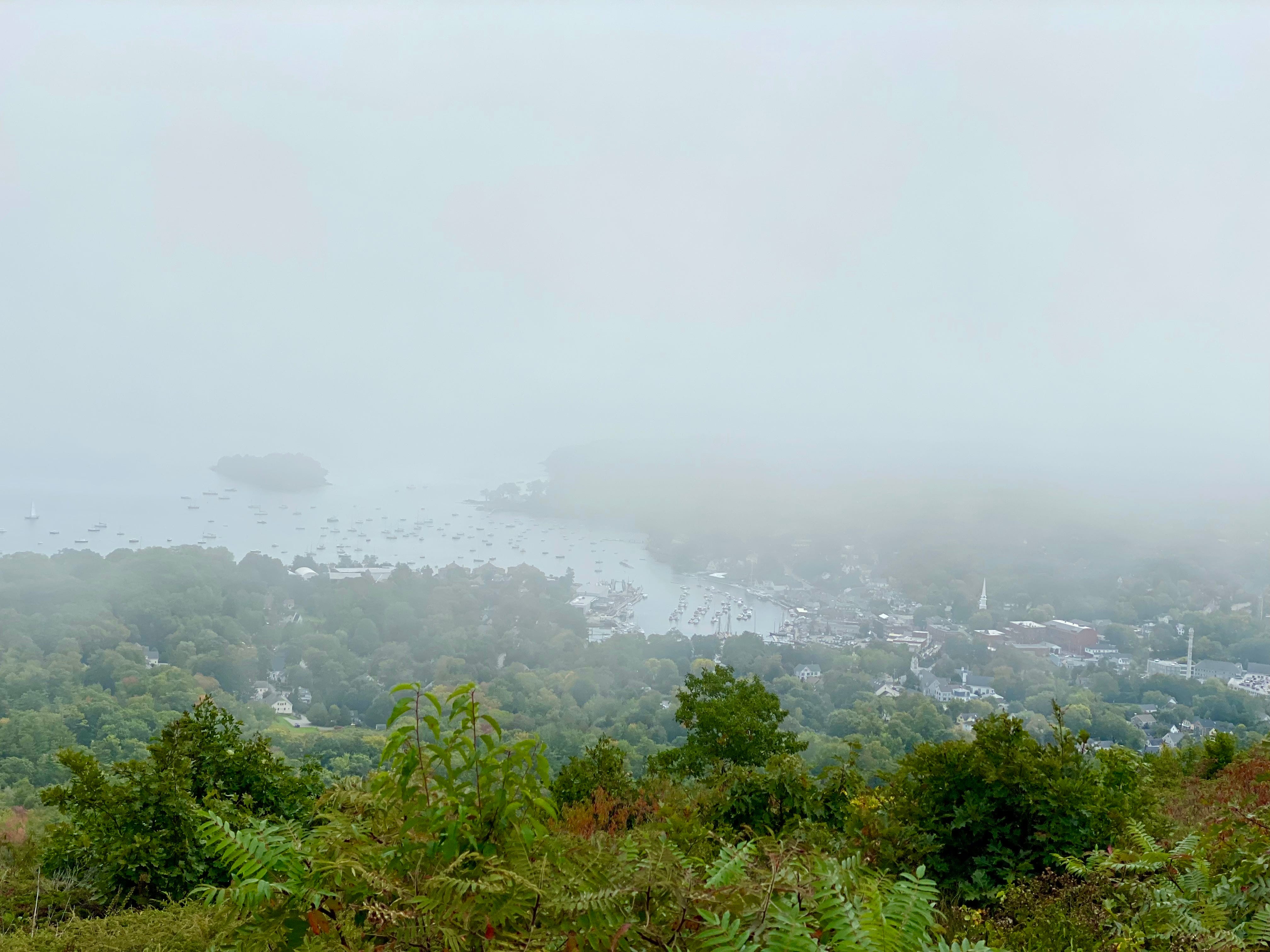
Two summers ago at seventy, my friend and I drove up the road to Mount Battie which for us was the only way we’d ever manage to get there now. It was a foggy day and at first there was no view at all. Then as the sun climbed higher in the sky, slowly the fog began to burn off and the harbor materialized with its many boats, an island beyond, and the town with church steeples, elms and the old mill. Camden will ever remain magical for me.
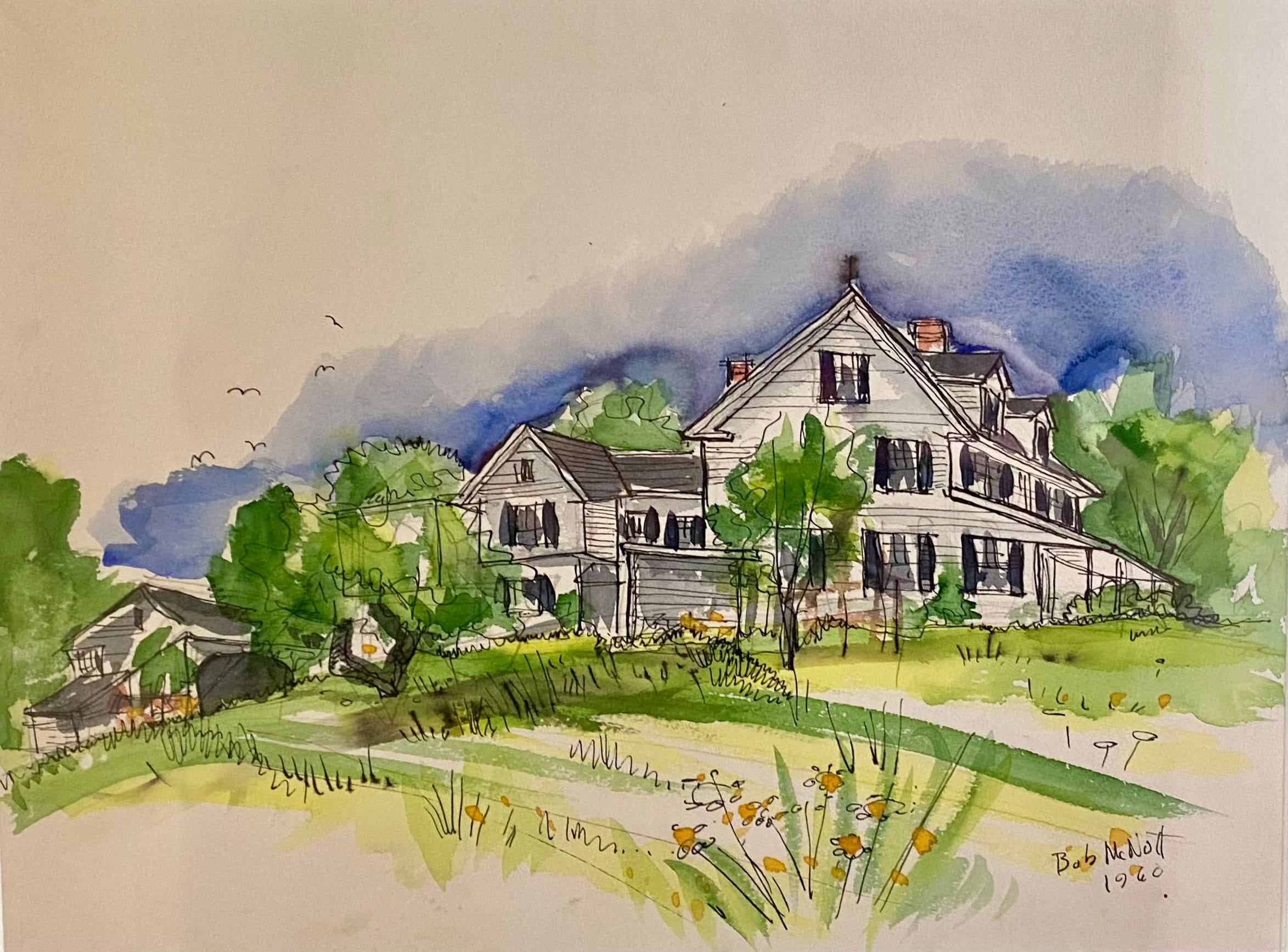
*The illustration for this post is a watercolor my father Robert A. McNutt, painted in 1960 during his first visit, and mine, to Camden. As an architect, he was enthralled by the unique yet classic construction of the stately old house with several more recent add-ons, such as bathrooms, sunroom and more modern annex. When I visited two years ago, my cousin asked if I had seen my father’s watercolor. I said, “He didn’t do watercolors!” She led me to a wall off the dining room and this painting looked back at me, signed by my father. Of course he could do illustrations such as this. He was an architect, after all, and did renderings for clients all the time. I now have an excellent reproduction of this painting in my dining room, and I had a second one made for my cousin Bob who shares my father’s name.